The Rule of 2 and 4: The Fastest Way to Estimate Your Equity
Holding a draw feels like holding a lottery ticket, and the question is always how likely the winning card is to show up. Exact answers need arithmetic that nobody wants to do while a clock is ticking, whether at a live table or on BC Poker. The rule of 2 and 4 replaces that arithmetic with a single multiplication that lands remarkably close to the truth. Below, the rule is tested on five specific hands, compared with exact figures, and patched for the spots where it overshoots. You will also see the one situation in which using it can mislead you.

The Idea Behind the Rule
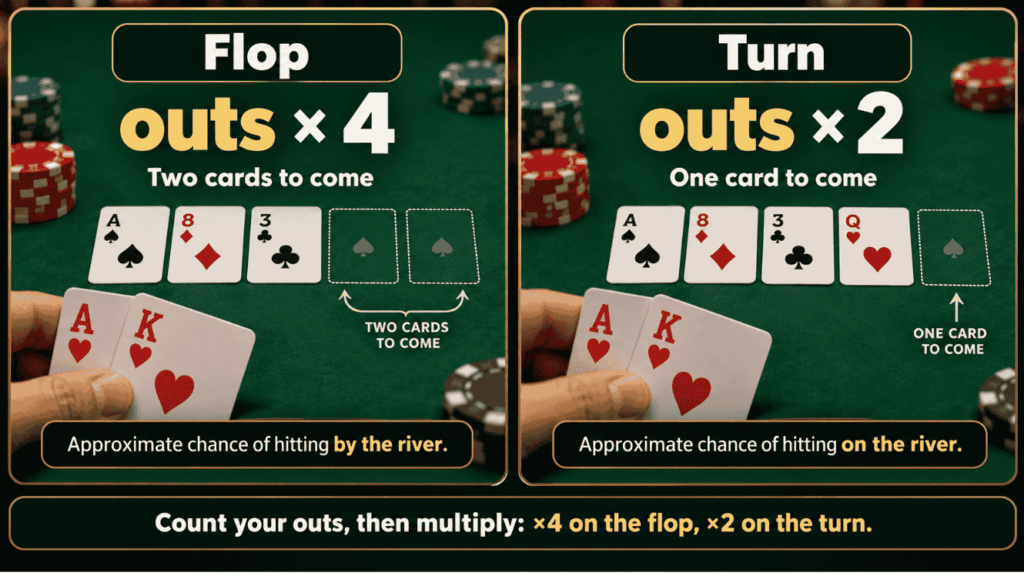
Every drawing hand raises the same question: how likely is the card I need to arrive? The rule of 2 and 4 answers it with one multiplication. First count your outs, which are the unseen cards that would make your hand good enough to win. Then:
- With two cards still to come, after the flop, multiply the number of outs by 4.
- With one card still to come, after the turn, multiply by 2.
The result is your approximate chance, in percent, of improving by the river. It takes a couple of seconds and stays remarkably close to exact math for the draws you meet most often.
Why It Works
After the flop, 47 cards are unseen from your point of view, and after the turn, 46. A single out therefore represents about one chance in 46 or 47, roughly 2%. When two cards are coming, you get two attempts, so each out is worth close to 4%.
For readers who like to check: the exact chance of hitting by the river is one minus the chance of missing twice. Written out, it is 1 − (47 − o)(46 − o) ÷ (47 × 46), where o stands for your outs. The rule is a rounded version of that expression.
Counting Outs on Concrete Hands
| Hand | Board | Draw | Outs | Rule of 4 | Exact (flop) |
| Q♥J♥ | 9♦ 8♣ 2♠ | Inside straight (needs a 10) | 4 | 16% | 16.5% |
| K♣Q♦ | 9♠ 5♥ 2♣ | Two overcards | 6 | 24% | 24.1% |
| 6♣5♦ | 7♠ 4♥ K♣ | Open-ended straight | 8 | 32% | 31.5% |
| A♠Q♠ | 8♠ 5♠ 2♦ | Flush draw | 9 | 36% | 35.0% |
| 10♦9♦ | 8♦ 7♣ 3♦ | Flush plus open-ended straight | 15 | 60% | 54.1% |
Example 1: Inside Straight
You hold Q♥J♥ and the board shows 9♦ 8♣ 2♠. Only a ten completes the run, and four tens remain. Four outs times four is 16%.
Example 2: Open-Ended Draw
With 6♣5♦ against 7♠ 4♥ K♣, either an eight or a three finishes the straight. That is eight cards, which gives 32% on the flop and 16% on the turn.
Example 3: Nut Flush Draw
A♠Q♠ on 8♠ 5♠ 2♦ leaves nine spades unseen. Nine outs times four is 36%, and the exact figure is 35%. On the turn the rule gives 18%, against 19.6% exactly.
Example 4: Combination Draw
Holding 10♦9♦ on 8♦ 7♣ 3♦, you have nine diamonds for the flush. A jack or a six also makes a straight, and the jack and six of diamonds are already counted among the diamonds, so only three jacks and three sixes are new. That is six more cards, for fifteen outs in total. The raw rule says 60%, while the true flop equity is about 54%.
The Correction for Big Draws
The rule grows optimistic as outs pile up, because the two chances to hit overlap. The remedy is quick: after multiplying by 4, subtract one point for each out beyond eight.
- Twelve outs: 48 minus 4 equals 44%, close to the exact 45%.
- Fifteen outs: 60 minus 7 equals 53%, close to the exact 54%.
The Most Important Caveat: When Do You Really See Two Cards?
Multiplying by 4 assumes you reach the river for the price of a single call. That holds when you are all-in or when no more betting is likely. In most hands, though, your opponent can bet again on the turn, and you must pay a second time before seeing the last card.
When that is the case, judge each street by itself and use the rule of 2 for the one card that is next. A player who sees “36%” and then pays a flop bet, a turn bet, and a river bet has paid three prices against an equity figure that only covered one of them.
Turning an Estimate Into a Decision
An equity estimate needs a price to be compared with. Suppose the pot is 30 and your opponent bets 10. You pay 10 to play for a pot of 50, so you need 20%. A nine-out flush draw has about 35% on the flop, so the call works comfortably.
Now the turn misses and the pot is 50. He bets 25. The price is 25 into a pot of 100, so 25%, while your draw has about 19.6%. The direct math says fold unless you expect to be paid well when the flush comes in.
In multiway pots, be stricter with your outs. If another player could hold a higher flush draw or a made hand that your card would not beat, discount the affected cards.
Using the Rule at the Table
The shortcut suits fast games where decisions arrive every few seconds. Many rooms allow several tables at once and prohibit real-time assistance software, so the estimate has to come from your own head. Some sites offer all-in insurance on the turn and river at cash tables, with the price derived from current pot odds, and a solid grasp of equity helps you judge whether that kind of offer fits a given spot. Games with forced flop action, such as bomb pots, create multiway pots from the first street, where your real equity is lower than a heads-up estimate suggests.
A Short Practice Routine
- Pick ten draws and write down the outs, the rule-of-4 value, and the exact number from an equity calculator during study time.
- Open your hand history, find hands where you called with a draw, and check whether you used the multiplier that fit the street.
- Say your out count aloud while you play until the counting becomes automatic.
Key Points to Remember
- Flop: outs × 4. Turn: outs × 2.
- Beyond eight outs, subtract one point per extra out from the flop figure.
- Use the larger multiplier only when no further bet will come before the river.
Combine those three habits with the price of the call and you have a complete, repeatable method for judging any draw.
Leave a Reply